
Ask most real estate developers where their leads come from, and you'll hear the same answer: their website, agency websites, listing platforms, year long Google Ads and Paid Search campaigns. Ask where buyers actually start their journey, and the answer has quietly changed. They start on Google, Gemini & AI platforms. They start in Maps. They start by typing the name of a neighbourhood and the words "new apartments" into a search bar.
If your projects aren't there at that moment, someone else's are.
This is the case for taking SEO seriously as a developer, not as a website upgrade, but as a compounding lead-generation asset that sits underneath every project you launch. Below is the strategic read, the business outcomes, and a practical starting point.
What SEO means for real estate developers
SEO, Search Engine Optimisation, is the practice of making your website, your project pages and your brand visible inside Google and Maps results when buyers, investors and partners search. In plain language: when someone types "off-plan apartments in [city]" or "[developer name] reviews" or "new launch in [area]", SEO is what decides whether they land on your site, a portal, or a competitor's project.
For developers specifically, the discipline looks different than it does for agents. Agents optimise for "homes/villas etc for sale in X". Developers have a narrower, higher-value problem: a finite number of units across a small number of projects, each with launch windows, phases and pre-sale targets. The wins look like this:
- A dedicated project page that ranks for the launch's branded search and its neighbourhood search.
- A developer brand that shows up cleanly when an investor Googles your name before a sales meeting.
- Neighbourhood guides that capture buyers two years before the next phase even breaks ground.
Real estate developer marketing is not the same conversation as agent marketing, and SEO for developers shouldn't be designed around a product listings feed.
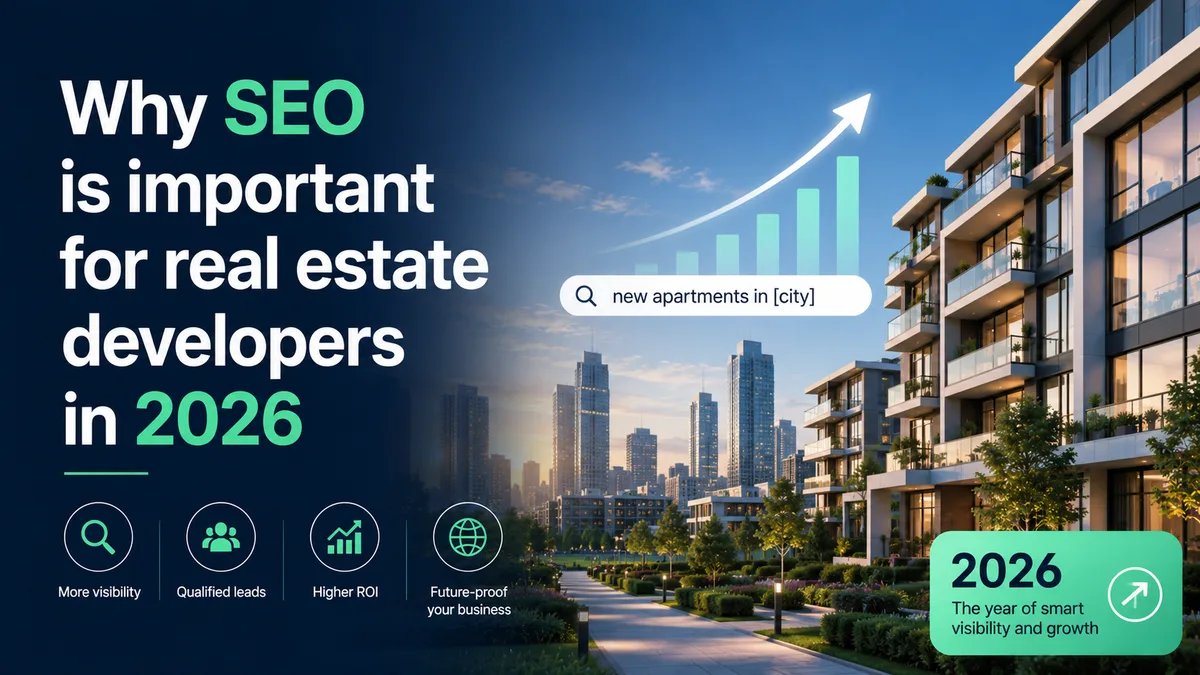
Why SEO is important for real estate developers in 2026
Three structural shifts have pushed real estate SEO from "nice to have" into core strategy.
Buyers and investors now do their research before they speak to anyone. By the time a buyer fills in an enquiry form, they've usually shortlisted projects, compared specs, watched a walkthrough and read about the neighbourhood. The window where a real estate agency controls the narrative has shrunk. Your search visibility is now the narrative.
Search intent is unusually high in this category. A query like "new apartments in [location]" or "off-plan projects in [city]" is not idle browsing: it's someone with intent, time and budget. There is very little wasted traffic in property search. A page that ranks for the right neighbourhood query brings a stream of qualified buyers that paid ads can't replicate at the same unit economics.
Portal and Real Estate Agency dependence is a margin problem. Every lead bought from a portal or commissioned to an agency shows up in your cost of sale. Organic leads for real estate projects captured directly through your own website change that maths. They lower blended cost per lead, give you first-party data on buyer behaviour, and reduce how much of your sales is gated by third-parties.
The business outcomes SEO moves
The mistake is to evaluate SEO as a website metric. The right lens is project-level commercial outcomes.
Faster sales. A well-optimised project page with floor plans, amenities, neighbourhood context and a clean enquiry path captures buyers who are already in the consideration phase. Stack that with a ranking neighbourhood guide and a Maps listing, and you compress the time from awareness to enquiry.
Direct enquiries, not just agency leads. When buyers search your project name or your developer brand, they should land on your own page, not a portal listing. That single change reroutes a meaningful share of leads through your funnel, owned, attributed, and at a lower marginal cost.
Investor and JV visibility. Institutional money, family offices and joint-venture partners need to find you on broader terms to discover your existence.
Stronger launches. A project that has been generating search visibility for the surrounding area for twelve months before launch enters the market with a warm audience. Pre-sales are easier when the buyer already trusts the developer's understanding of the corridor.
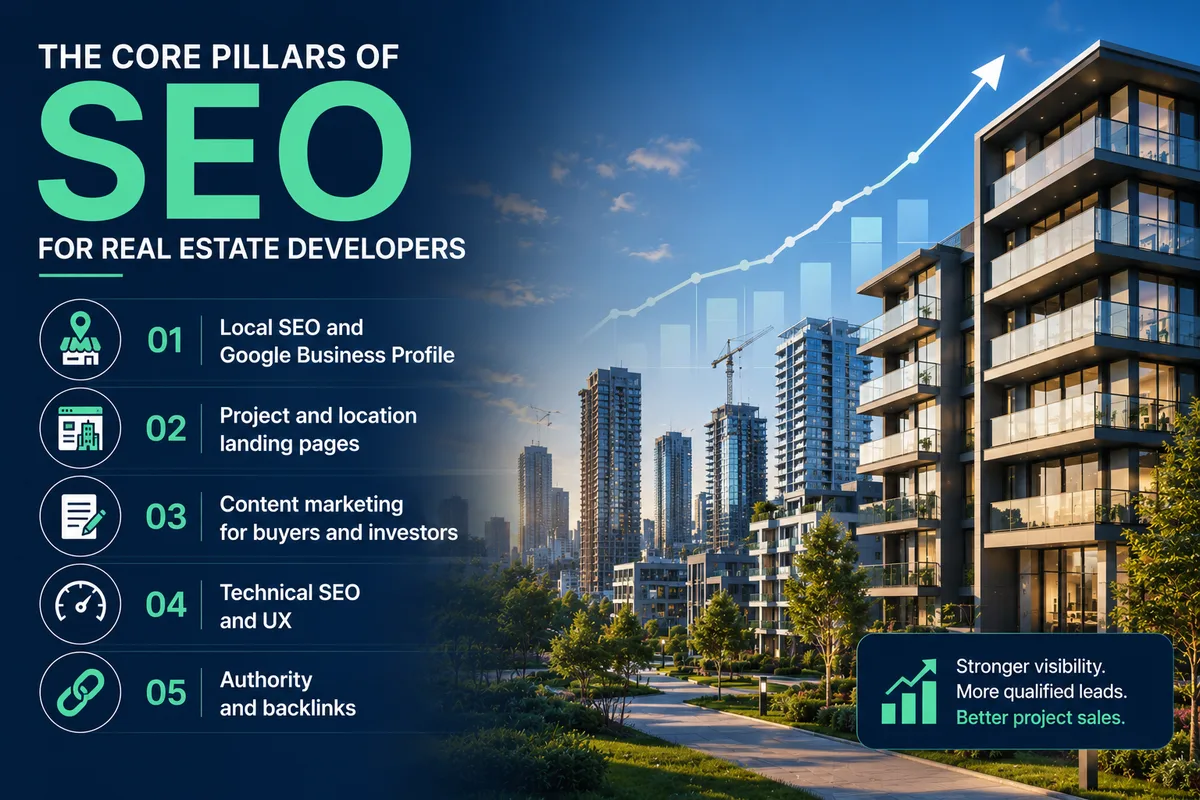
The core pillars of SEO for real estate developers
Five pillars carry most of the value. Treat them as a system, not a checklist.
1. Local SEO and Google Business Profile
Most high-intent property searches are local. "[City] property developer", "[area] apartments", "off-plan in [neighbourhood]" — all of these trigger Maps results before they trigger blue links. Local SEO for property developers is non-negotiable.
That means a fully completed Google Business Profile for the developer brand, with consistent NAP (name, address, phone) across your site, directories and listings. It means real reviews from buyers and partners, frequent photo uploads from sales galleries and site visits, and posts that flag project updates and launch milestones. It also means content-rich pages such as your blog articles and regional guide pages to explain thoroughly the benefits of the area.
2. Project and location landing pages
This is where most developer websites underperform. A typical project page is a brochure converted to HTML beautiful, but invisible to search. The pages that earn organic leads for real estate projects are richer: unique copy describing the development, floor plan galleries with proper image SEO, amenities written out (not just iconified), a neighbourhood section with distances to schools, transit and commercial nodes, and internal links to related projects and area guides.
Pair each project page with a corresponding neighbourhood page. The project page ranks for the launch and the brand. The neighbourhood page sub pages (or blog articles) ranks for the long tail "is [area] a good place to invest", "schools near [area]", "apartments near [transit hub]" and feeds qualified buyers into your project funnel.
3. Content marketing for buyers and investors
Buyers spend months in research before they commit. The content that captures them at that stage isn't a project brochure, it's the guide that helped them decide on the neighbourhood, the asset class or the buying structure.
The high-value formats:
- Buyer guides. "How to buy off-plan in [city]", "What to check before signing", "Payment plans explained".
- Investor guides. "Is [area] a good place to invest?", "Rental yields in [city] by neighbourhood", "Off-plan vs. ready-to-move ROI".
- Neighbourhood deep-dives. "Guide to [neighbourhood]" including schools, transit, lifestyle, future infrastructure, comparable transactions.
4. Technical SEO and UX
None of the above ranks if the underlying site is slow, fragile or mobile-hostile. Property searches are mobile-first by default. A project page that takes five seconds to load on 4G has already lost the buyer. Lean Search specialises in Technical SEO, content copywriting and landing page development for specific context and purposes.
The non-negotiables: fast page loads, clean mobile layouts, crawlable architecture, no duplicate content scraped from portal feeds, canonical tags on near-duplicate pages, and structured data (schema markup) on every project and listing so Google can render rich snippets, price, location, status, images, directly in the result. Real estate is one of the categories where rich results meaningfully change click-through rates.
5. Authority and backlinks
SEO is downstream of trust. Trust, to a search engine, is partly a function of who links to you. For a developer, the right backlink profile is built locally and within the industry: regional press covering launches, partnerships with architects and design firms whose sites link to the project, association memberships, planning authority registers, investment newsletters and credible directories.
Avoid the noise. A single link from a respected local business publication is worth more than two hundred links from automated directories. Treat each link as a small endorsement of your brand.
SEO vs. paid ads and portals
Paid ads and portals are extremely useful, especially for launch and year-long leads. But they share a structural dependency: the moment you stop paying, the leads stop arriving. Receiving leads from organic traffic as well as paid traffic doubles the volume.
SEO works the other way. A project page that ranks well in month three is still ranking in month eighteen, still generating enquiries, still feeding your sales team. A neighbourhood guide written for one project keeps generating leads for the next three projects you launch in the same corridor. The investment compounds across launches, across phases, and across your entire portfolio.
For a developer who plans to be in a market for the next decade, that compounding is the entire point.
The bottom line: YES SEO is vital for Real Estate Developers
Yes, SEO is important for real estate developers, arguably more important here than in most categories. Search intent is high, individual transaction values are large, and the cost of buyer acquisition through portals and real estate agents continues to climb.
If you're a real estate developer who wants to reduce your dependence on portals and brokers, start with one corridor and one project. Get the project page right, claim the local search territory around it, and build the neighbourhood content that brings buyers to you directly. That's the foundation. Everything else compounds on top.
Want to see how your projects and brand currently read to Google, and where the highest-leverage opportunities sit? Book a strategy call or read more about our SEO approach.