The frequent question we get as an SEO Company in Mauritius is whether SEO is still important and relevant when there are AI Engines. Lean Search, as the fist and only dedicated Search Marketing company in Mauritius brings you the answer from the giant itself. Google has published official guidance for site owners on how to perform inside its generative AI features (AI Overviews) and the newer AI Mode.
The short version, in their words and ours: it's still SEO. The mechanics underneath have changed. The discipline hasn't.
Is SEO still relevant for generative AI search?
Yes. Google is direct about this.
The generative experiences sit on top of the same ranking and quality systems that govern the classic blue links. The AI layer doesn't bypass the index, it queries it, then summarises. Which means the work that ranks a page is the same work that positions it to be cited inside an AI Overview.
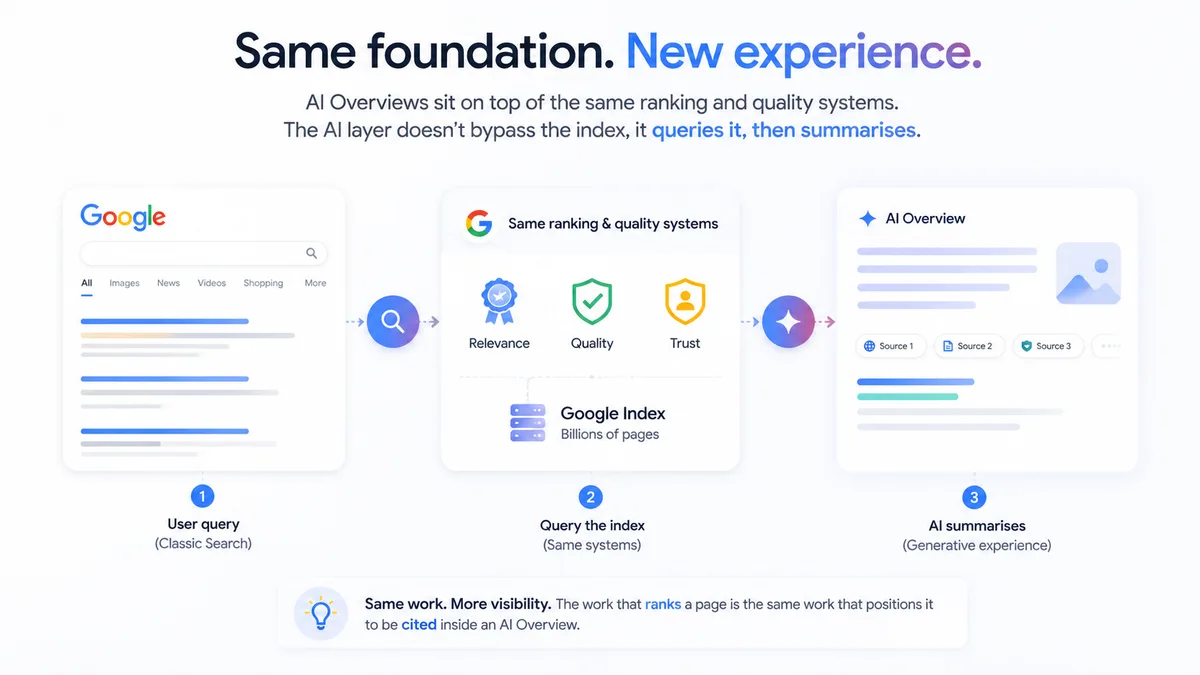
If you've already invested in technical health, content quality, internal linking and authority signals, you've already invested in being part of the AI answer set. The acronym on the brief doesn't change the discipline.
Two mechanics worth understanding
Google calls out two specific techniques powering the generative experience.
Retrieval-augmented generation (RAG). The model doesn't answer from a frozen training set. It runs the query against the live Search index, pulls the most relevant pages, then synthesises a response grounded in what it found. The cited sources appear as clickable links inside the AI Overview — that's how the user gets back to your site.
In plain English: the AI is grading your page in real time, and when it cites you, it sends a clickable link with the citation. That click is the new front-page ranking.
Query fan-out. When the user asks a question, the model doesn't just answer the literal query. It spins out a set of related sub-queries and pulls sources for each of them. Google's own example: "how to fix a lawn that's full of weeds" fans out into "best herbicides for lawns", "remove weeds without chemicals", and "how to prevent weeds in lawn", each pulling its own set of citations.
The consequence: a page only needs to be the best answer for one of the fan-out queries to make it into the synthesis. Coverage depth — not just landing one keyword — is what keeps you in the citation set.
AEO. GEO. AIO. Pick one.
Marketers have invented new acronyms for the generative era — answer engine optimisation, generative engine optimisation, AI optimisation. Pick whichever helps you sell the work internally. Google's position, and ours, is that they describe the same discipline.
Optimising for AI Overviews is optimising for the search experience. The search experience is what SEO has always been. The acronym change doesn't unlock a new technique that the existing best practices don't already cover.
What this actually changes for your site
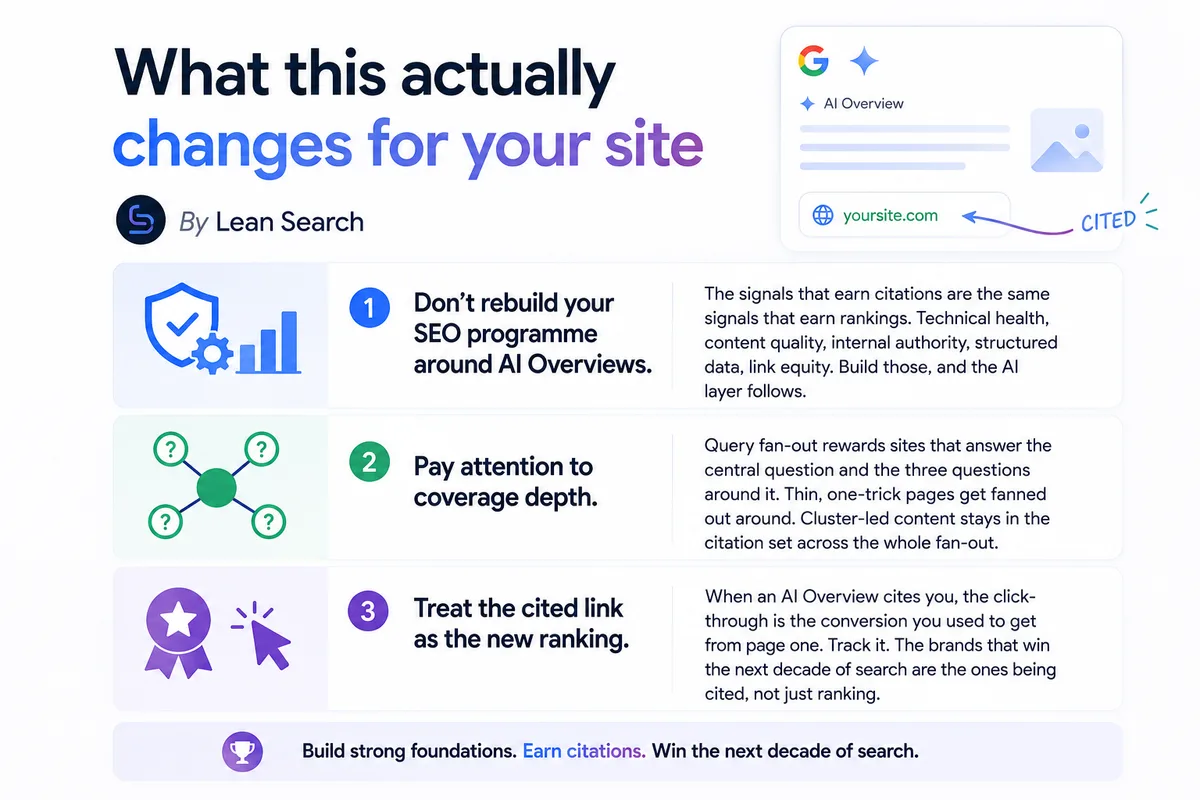
1. Don't rebuild your SEO programme around AI Overviews. The signals that earn citations are the same signals that earn rankings. Technical health, content quality, internal authority, structured data, link equity. Build those, and the AI layer follows.
2. Pay attention to coverage depth. Query fan-out rewards sites that answer the central question and the three questions around it. Thin, one-trick pages get fanned out around. Cluster-led content stays in the citation set across the whole fan-out.
3. Treat the cited link as the new ranking. When an AI Overview cites you, the click-through is the conversion you used to get from page one. Track it. The brands that win the next decade of search are the ones being cited, not just ranking.
Lean Search's take
We've been optimising for generative search since AI Overviews shipped. Google's guidance confirms what we've been building into client engagements all year: the foundations don't change, the surface does. If your site is structured to be retrievable, citable and authoritative, generative search is a tailwind. Not a threat.
If you want to know how your site reads to the citation layer, and which fan-out queries you should be in the source set for — book a strategy call. We'll show you the model.
Source: Google Search Central — Optimizing your website for generative AI features on Google Search.