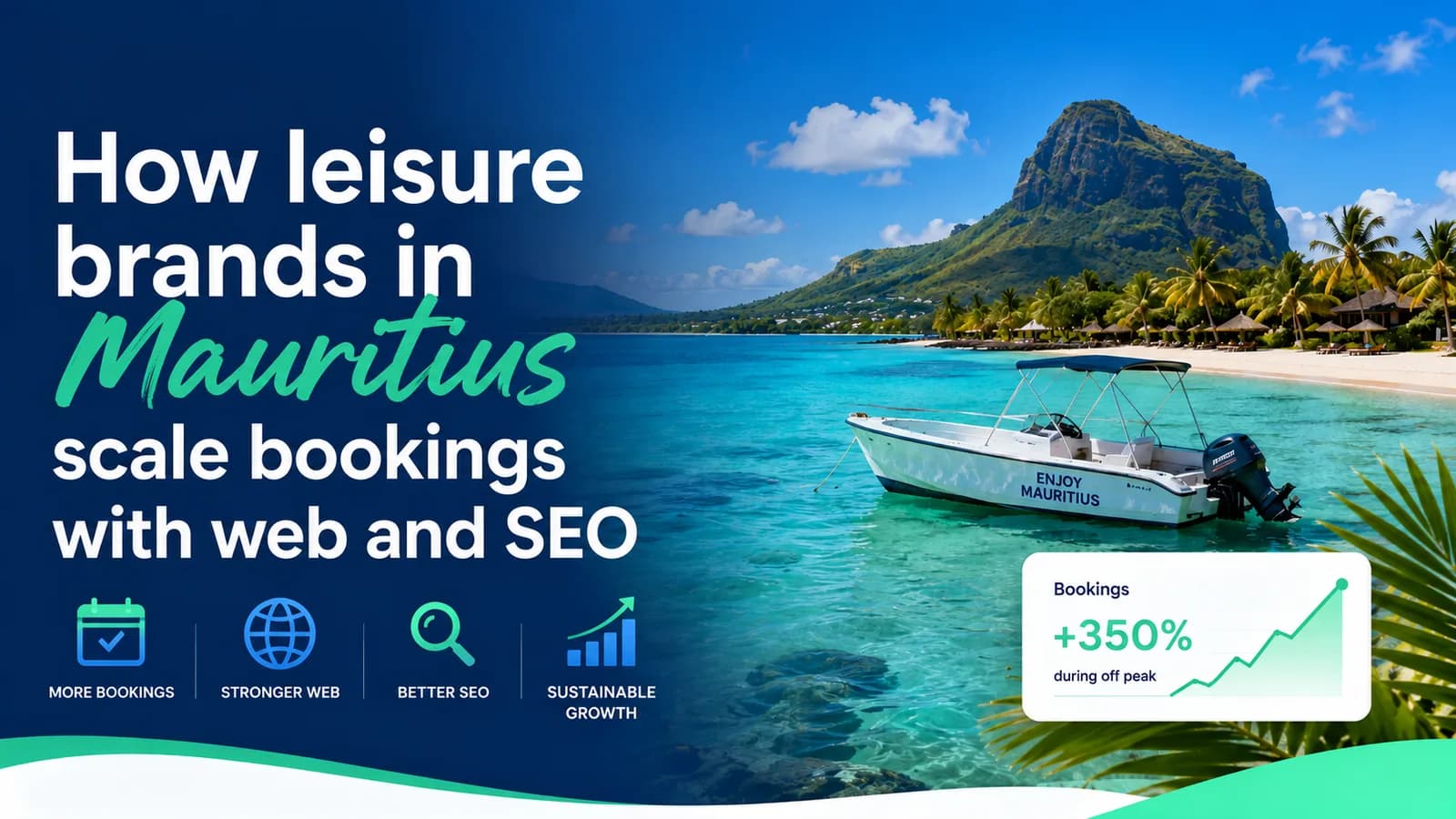
Mauritius has quietly become one of the most competitive leisure markets in the Indian Ocean. Catamaran cruises, speedboat excursions, islet transfers, private charters, the offer is broad, the operators are sophisticated, and the international demand is real. What separates the operators stuck at flat growth from the ones scaling exponentially is not the boats. It's the digital engine behind the bookings.
Here's the read on what actually drives that scale and how Lean Search structures the work for leisure brands in Mauritius.
The market reality: paid ads got you here, organic gets you to the next level
Lean Search has been a preferred partner over the years with a well reputed leisure operator in Mauritius that had scaled its asset base significantly, expanding into sunrise and sunset catamaran trips, full-day and half-day excursions, and premium private experiences. Most of that growth had been fuelled by Paid Search and Google Ads. It worked.
The problem with a paid-only model is structural: the second the budget pauses, the bookings pause. For an operator with a fleet, fixed costs and a sales calendar tied to seasonality, that's a good foundation but it needs to be reinforced with organic traffic.
The next phase, the one most ambitious operators in Mauritius are now entering is building a website and organic strategy that compounds. Paid ads are still useful for launches and peak windows. But the long-term acquisition engine is the website plus SEO plus content. Done properly, it works while you sleep.
Choosing the right website approach
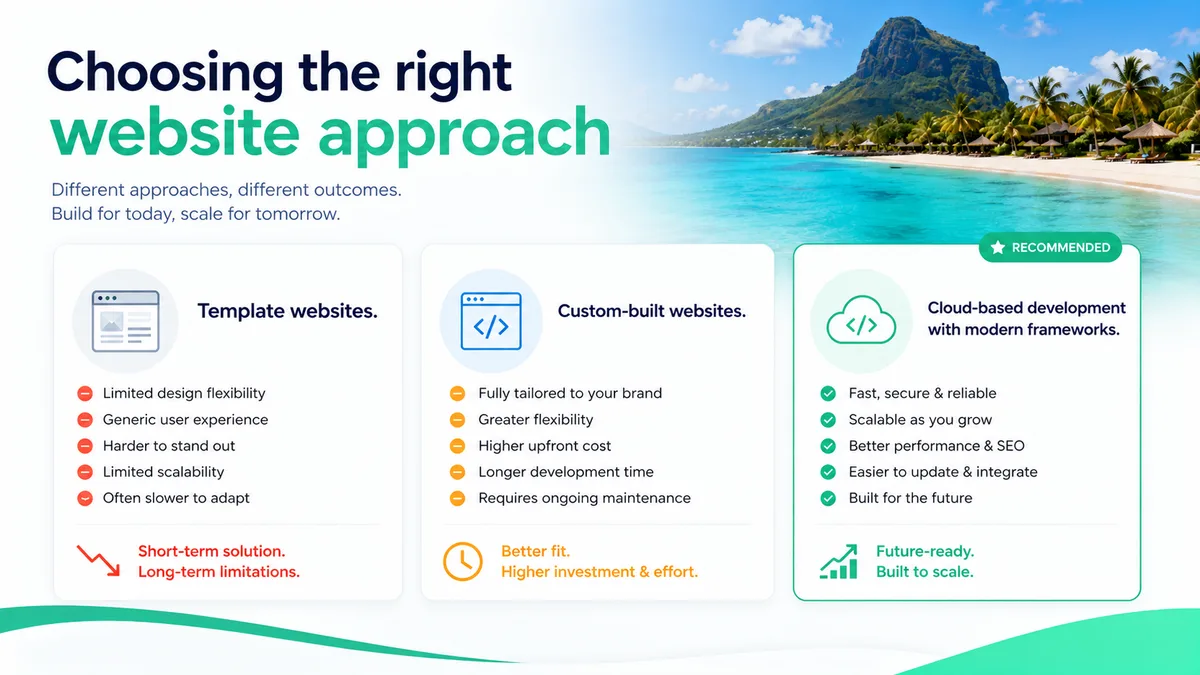
There is no one-size-fits-all website. The right answer depends on growth ambition, brand positioning and how international the audience is.
Template websites. Fast to ship, affordable, and useful for early-stage businesses validating a market. The trade-off is flexibility. Templates struggle to express a premium brand identity, and they hit a ceiling quickly when you need bespoke booking flows, multilingual content or custom integrations. Good for year one. Limiting beyond it.
Custom-built websites. Full control over design, brand, and user experience. For leisure operators with multiple assets: boats, premium experiences, possible hospitality extensions. A custom build lets you express a single identity across every touchpoint. It costs more upfront and rewards the investment over the lifetime of the brand.
Cloud-based development with modern frameworks. Frameworks like React and Next.js deliver ultra-fast, mobile-first websites that load in under a second on 4G. Combined with AI-assisted design and development, this approach compresses build times and costs while keeping the long-term scalability of a custom build. For ambitious operators targeting international travellers, especially from Europe, this is increasingly the default.
For brands aiming to compete for premium, internationally-sourced bookings, a custom or cloud-based build is usually the right long-term call - Noor Sheriff
SEO that actually drives bookings
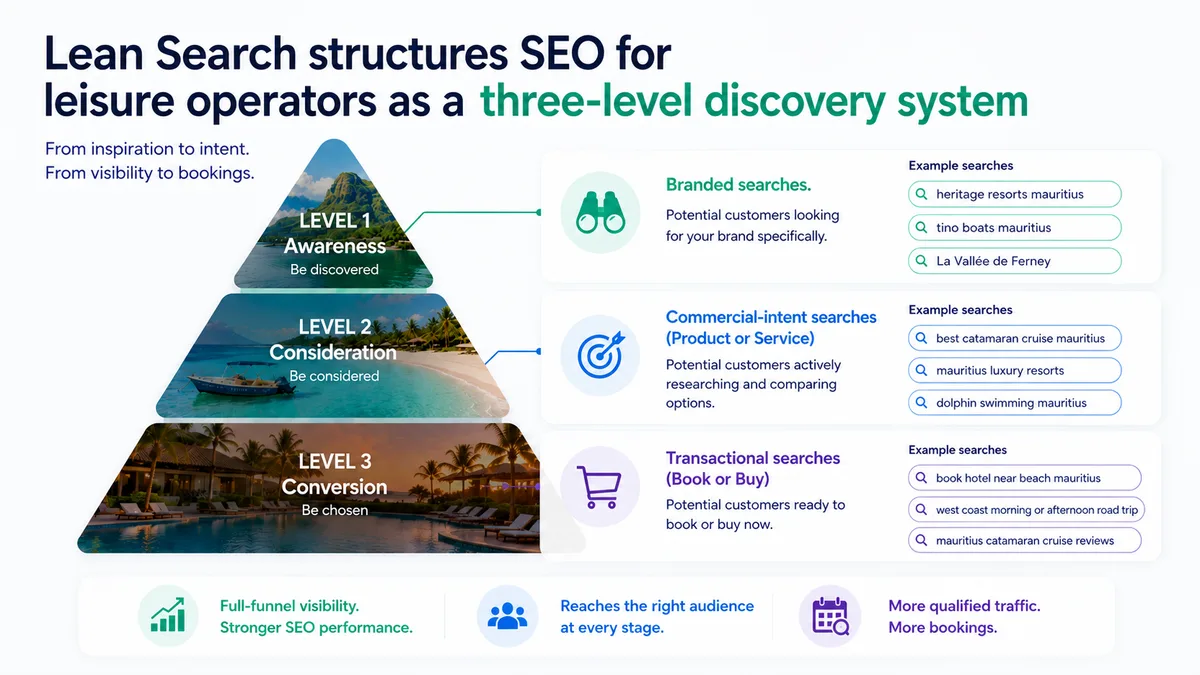
A website that doesn't rank is a brochure. The difference between a brochure and an acquisition asset is search architecture. Lean Search structures SEO for leisure operators as a three-level discovery system.
Branded searches. When a traveller hears your name on the beach, sees a flyer at the hotel, or gets a recommendation from a friend, the first thing they do is type your company name into Google. Your site must own that result completely above portal listings and aggregators.
Commercial-intent searches. This is where the bookings come from. "Catamaran trip Mauritius", "speedboat Ile aux Cerfs", "private boat charter Mauritius", "sunset cruise north coast", "coin de mire boat trip", these are queries with intent, time and budget behind them. Ranking on the first page for the right basket of commercial keywords is the most reliable booking flow a leisure operator can build.
Informational searches. Travellers research their trip three to six months before they arrive. They search "best things to do in Mauritius", "east coast vs west coast Mauritius", "Mauritius in November". Capturing this early-stage demand with guides and travel content is how you put your brand in the consideration set before they even know which operator they'll book.
That structure rests on three pillars done consistently.
- Technical clarity. Clean architecture, fast load times, no duplicate content, schema markup so Google can render rich results.
- Content depth. Each commercial page supported by contextual content, neighbourhood guides and internal linking that builds topical authority.
- Consistency. Publishing and refreshing content on a steady cadence. SEO rewards persistence; it punishes one-off campaigns.
The result is a website that stops being a digital brochure and becomes a long-term acquisition engine.
Turning traffic into bookings
Ranking is upstream. Bookings are the outcome that matters. A leisure brand that drives traffic but doesn't convert is paying for visibility without revenue.
For Mauritius leisure operators, that means integrating a booking system that matches the way real customers want to pay:
- Full online payment for friction-free conversion on standard products like catamaran cruises and group excursions.
- Partial deposit options typically 50% to reduce drop-off on higher-ticket private experiences where travellers want to lock the date without committing the full amount upfront.
- Inquiry-based booking for premium and customised experiences where conversation closes the deal better than a checkout button.
Real-time availability is non-negotiable. Double bookings are a brand-killer in a market that runs on reviews. Automation confirmation emails, receipts, WhatsApp integration for itinerary and weather updates removes the operational drag that scales worse than the booking volume.
Lean Search recommendation wires booking systems into the operator's existing stack, including tools like Odoo CRM or of the likes. The point is centralisation: customer data, email marketing, repeat-booking flows and performance reporting all flowing through one source of truth, not stuck in disconnected spreadsheets.
Content that builds authority and demand
Organic growth needs more than service pages. The leisure brands building durable demand in Mauritius are investing in content that attracts travellers months before they book.
Destination guides. "Ultimate guide to the east coast of Mauritius", "What to do in the north in three days", "Mauritius in October, weather, sea conditions, what's open". These pages catch travellers in the research phase and route them back to the experiences you actually sell.
Experience comparisons. "Catamaran vs speedboat vs private charter, which is right for your trip?". Honest, useful comparisons earn trust and rank for high-volume queries that pure product pages can't reach.
Audience-specific planning content. French travellers, honeymooners, families with young children, dive enthusiasts, corporate retreats. Each segment has different questions, different price tolerance and different decision cycles. The content should reflect that.
Video is the other half of the equation. Short-form video, especially in English, optimised for TikTok and Instagram Reels, drives discovery in a way written content can't. The same clips, repurposed on the website and YouTube, with proper subtitles and structured markup, double as engagement and SEO assets. One shoot, multiple distribution channels, compounding return.
UX and lead capture for the travellers who don't book today
Most first-time visitors won't book on the first visit. The website needs to be designed for that reality.
- Downloadable guides ("Guide to East Coast Mauritius") in exchange for an email address, building an owned audience the operator can market to repeatedly, at zero marginal cost.
- AI chatbots to answer the common questions instantly: boat capacity, included meals, weather contingency and reduce drop-off in the consideration window.
- Personalised user journeys that reflect premium positioning. A returning visitor who looked at private charters last week should not see the same page as a first-time visitor browsing group cruises.
These features turn a website from a one-shot conversion tool into a retention asset.
Lean Search's approach
The work is structured. Four phases, in order:
- Website architecture: the arborescence, mapping every page, internal link and content cluster before a single pixel is designed.
- SEO-driven content creation: copy written by real humans, for ranking and conversion, not just brand tone.
- Design aligned with brand positioning premium operators get premium design; the visual language has to match the price point.
- Development and integration clean, fast, mobile-first build, with the booking system, CRM and analytics wired in from day one.
Project budgets for leisure operators in Mauritius typically sit in the USD 15,000–20,000 range, depending on the scope of integrations, the number of languages and the depth of the content programme. For that investment, the operator gets a scalable digital asset designed to generate bookings consistently, not a website that needs to be replaced every two years.
The opportunity
For leisure brands in Mauritius targeting both local and international travellers, the strategic picture is clear. Pair high-performance web development with a structured SEO and content engine. Build a booking flow that matches how customers actually want to pay. Layer in lead capture for the long tail of future bookings.
The result is not just more visibility. It's sustained, compounding growth, bookings that arrive whether or not the paid budget is running, in a market where the operators thinking this way will pull ahead of the ones still treating their website as a brochure.
If you're a leisure operator in Mauritius ready to move beyond paid-only growth, book a strategy call or read more about our SEO approach. We'll show you what the next phase looks like for your fleet.